
Walking is one of the best things you can do for your health.
It’s free. It doesn’t require a gym membership. You can do it almost anywhere. And unlike many exercise programs, it doesn’t require special equipment or the ability to twist yourself into a pretzel.
So, if walking is so good for you, can you simply walk more to speed up a sluggish metabolism?
Unfortunately, no.
Walking absolutely supports metabolic health, but if your metabolism has slowed—particularly in midlife—adding more and more steps isn’t necessarily the answer.
Here’s what walking can do, what it can’t do, and what else your metabolism needs.
Walking Does Plenty of Good Things
First, don’t stop walking.
Regular walking and other forms of physical activity can improve cardiovascular health, help regulate blood sugar, increase insulin sensitivity, support weight management, and reduce the amount of time you spend sitting.
Walking after meals can be particularly useful because your muscles use glucose for energy, helping your body manage the rise in blood sugar that occurs after eating.
And walking burns calories.
But that’s where people sometimes get tripped up.
If 8,000 steps are good, wouldn’t 15,000 be better? And if you’re gaining weight, why not just walk another mile?
Because your metabolism is more complicated than your step count.
Your Metabolism Isn’t Just About Exercise
When people talk about having a “slow metabolism,” they’re usually thinking about how many calories their bodies burn.
But your metabolism includes all the chemical processes your body uses to keep you alive and functioning—from breathing and circulating blood to digesting food and repairing cells.
A large portion of the calories you burn every day has nothing to do with exercise. Your body uses energy around the clock simply to keep you alive.
Age, genetics, body size, hormones, sleep, nutrition, activity level, and muscle mass can all influence your total daily energy expenditure.
That means you can’t necessarily fix a metabolic slowdown by piling on more cardio.
Muscle Is the Missing Piece
This is especially important as we get older.
Beginning in midlife, we gradually lose muscle unless we actively work to maintain it. Less muscle can mean lower strength, reduced function, and fewer metabolically active tissues to support healthy aging.
That’s why strength training deserves a place alongside walking.
Resistance training sends your body the message: Keep this muscle. I need it.
You don’t need to become a bodybuilder. Using weights, resistance bands, machines, or body-weight exercises two or three times a week can help preserve and build muscle.
Think of walking and strength training as partners rather than competitors.
Walking keeps you moving.
Strength training helps you keep the muscle that allows you to keep moving.
Don’t Forget Protein
Exercise is only part of the equation.
Your body also needs adequate protein to maintain and repair muscle tissue. That becomes increasingly important with age.
Rather than saving most of your protein for dinner, try including a good source at each meal.
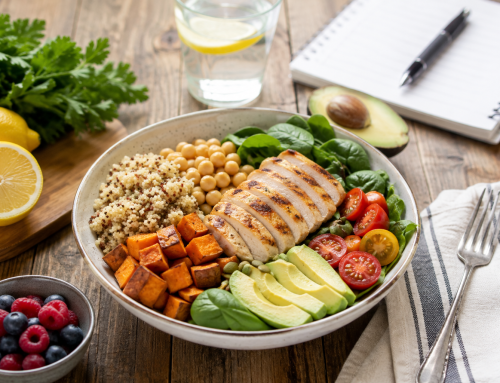
Eggs, Greek yogurt, cottage cheese, fish, chicken, tofu, beans, lentils, and other protein-rich foods can all contribute.
Pairing protein with high-fiber carbohydrates and healthy fats can also help with satiety, steadier energy, blood sugar management, and overall metabolic health.
More Exercise Isn’t Always the Answer
There’s another trap worth avoiding: assuming that if your weight changes, you simply need to exercise more.
Sometimes that turns into longer walks, extra cardio sessions, and fewer calories.
That combination can be counterproductive if it leaves you exhausted, overly hungry, under-fueled, or without enough recovery time.
Your body needs movement, but it also needs food, sleep, recovery, and muscle-building activity.
Healthy aging isn’t a contest to see how many calories you can burn.
Walk—But Give Your Metabolism More
Keep taking your walks. They’re doing your body a lot of good.
But don’t expect your step count to do everything.
If you want to support your metabolism as you age, think bigger: walk regularly, strength train, eat enough protein, prioritize sleep, manage stress, and give your body time to recover.
You can’t outwalk a slow metabolism.
But you can give your body the tools it needs to work better.
Work With Lorie
I help women over 50 across Irvine, Tustin, Newport Beach, Costa Mesa, and greater Orange County support their metabolism and stay strong through realistic, sustainable habits without another restrictive diet.
Ready to give your body what it actually needs? Book a Discovery Call and let’s talk.