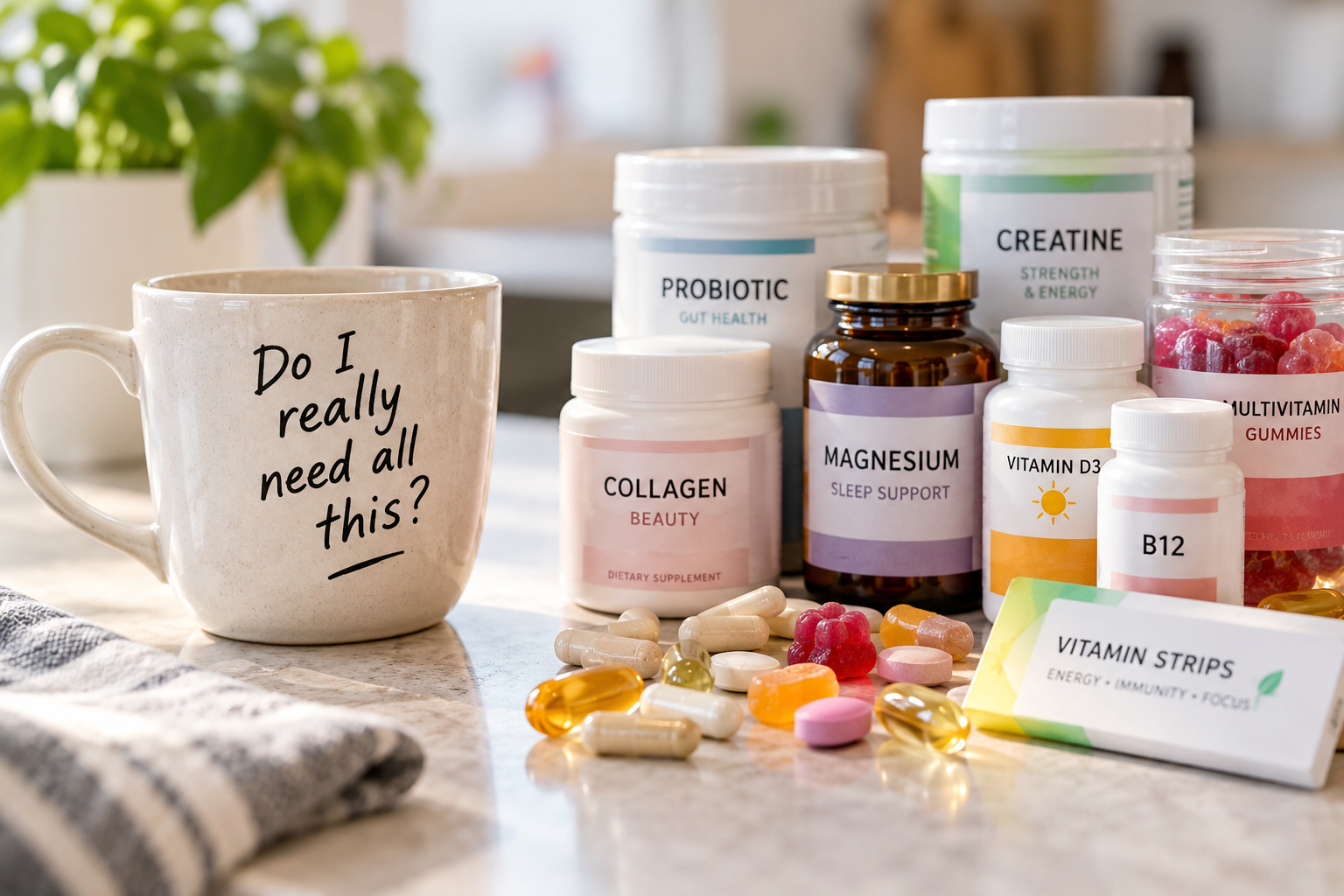
Apparently, turning 50 means you need a whole new collection of pills, powders, and gummies. Collagen for your wrinkles. Magnesium for sleep. Probiotics for your gut. Something to balance your hormones. And now vitamin strips that dissolve on your tongue. What’s next? Vitamins delivered by drone?
The supplement industry knows its audience. We’re concerned about losing muscle, gaining belly fat, sleeping poorly, and occasionally forgetting why we walked into a room. For every concern, there’s a bottle promising a solution.
But here’s the No-BS question: Do you actually need any of this stuff?
Your body isn’t falling apart at 50
Let’s give supplement marketers some credit. They’re terrific at turning ordinary worries about aging into shopping opportunities. “Supports brain health” sounds impressive. But does it mean you’ll remember where you left your keys? Probably not because of that bottle.
Unlike prescription medications, dietary supplements generally don’t have to demonstrate effectiveness before they’re sold. The FDA regulates supplements, but it doesn’t routinely approve them for safety or effectiveness before they reach stores. That doesn’t mean every supplement is useless or dangerous. It means the advertising deserves a healthy dose of skepticism.
What’s actually worth considering?
I’m not anti-supplement. I’m anti-wasting-money-on-stuff-you-don’t-need. Some supplements make sense for specific people, especially when food intake, medications, or medical conditions create a gap.
Take vitamin B12. Absorbing it from food can become harder with age, and certain medications interfere with absorption. If you’re deficient, supplementation can help. But extra B12 won’t give you superhuman energy if your levels are already adequate.
Calcium and vitamin D matter for bone health, especially after menopause. Women over 50 generally need 1,200 milligrams of calcium a day, including what’s in food. That doesn’t automatically translate into a calcium pill. Vitamin D needs also vary; more isn’t necessarily better.
Creatine is another interesting example. Research suggests it can modestly improve strength in older adults when paired with resistance training. Notice that last part? You still have to lift weights. Sorry.
Now for the expensive promises
Collagen sounds irresistible: drink a powder, smooth your wrinkles, and perhaps give your joints a tune-up. But a 2025 review found that the apparent skin benefits didn’t hold up when researchers focused on higher-quality studies and studies without industry funding. That’s a good reason to be skeptical of dramatic claims.
Probiotics are another favorite. Some specific strains can help with specific conditions, but buying a product with billions more bacteria doesn’t automatically make it better. And magnesium? It’s essential, but evidence that taking extra reliably cures insomnia remains limited. An important nutrient isn’t automatically an effective treatment for every problem listed on Instagram.
Then there’s the packaging. Gummies, powders, liquids, and dissolvable strips make familiar ingredients seem like exciting breakthroughs. Some formats are genuinely more convenient. But strawberry flavor and clever delivery don’t prove a product works better.
One more thing: supplements can interact with medications, and high doses of certain nutrients can cause harm. “Natural” isn’t a synonym for “harmless.”
The No-BS takeaway
Before buying another bottle, ask what problem you’re trying to solve, whether good evidence supports the product, and whether you’re already getting enough from food. If you’re concerned about a deficiency, ask your healthcare provider whether testing or supplementation makes sense.
Sometimes a supplement is exactly what’s needed. Other times it’s an expensive way to feel like you’re doing something healthy. Meanwhile, the fundamentals haven’t changed: eat well, build muscle, move regularly, and protect your sleep.
Not terribly glamorous. Nobody’s getting rich selling that advice.
You don’t need a supplement for every birthday. You need a good reason for every supplement.
Lorie Eber, The No-BS Nutritionist, is a Certified Wellness Coach and Nutritionist who helps women over 50 cut through the confusion around nutrition, menopause, sleep, stress, and healthy aging so they can feel stronger, healthier, and more confident.