
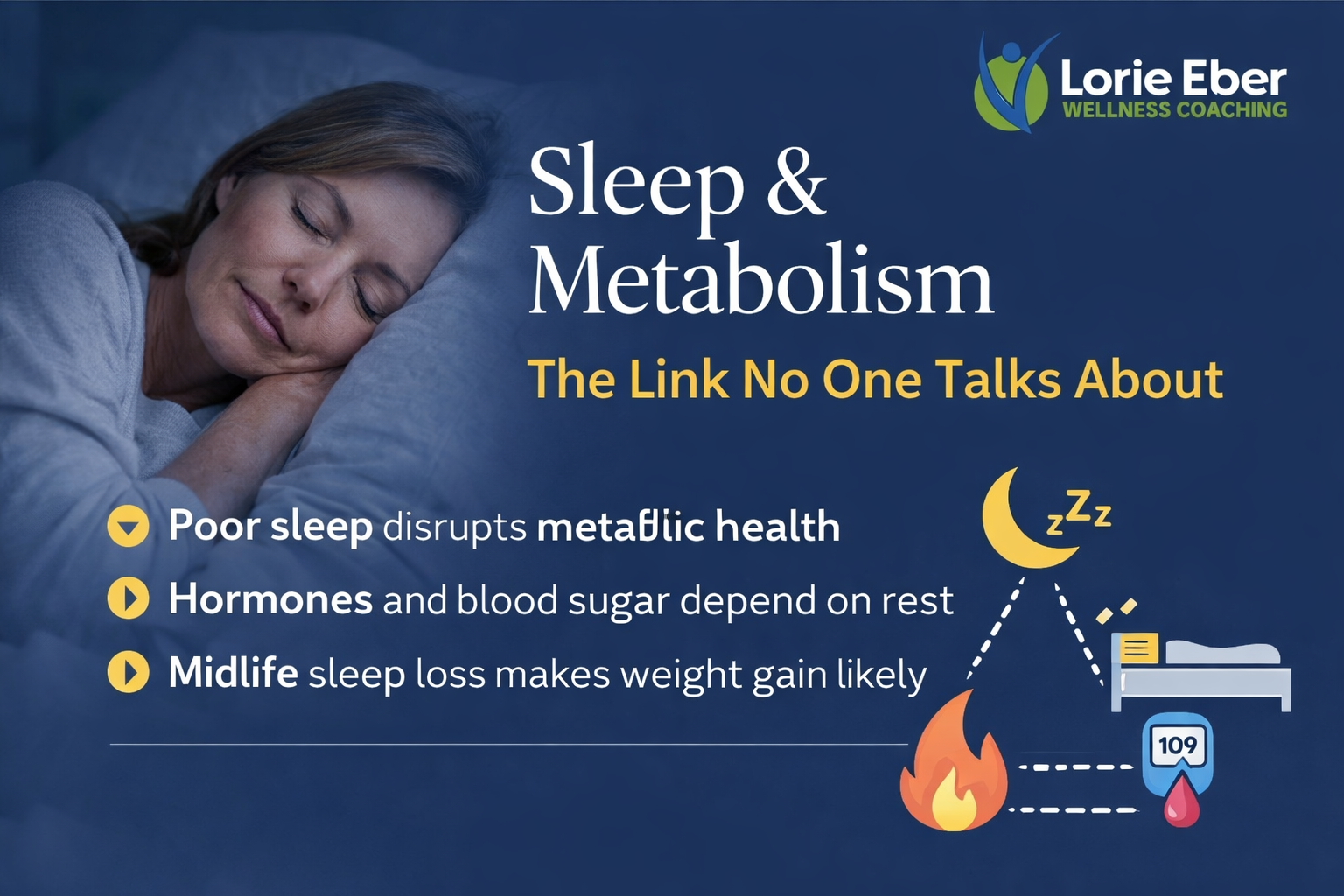
Sleep and Metabolism: Why Poor Sleep Slows Metabolic Health in Midlife
Most people think metabolism improves through workouts, strict diets, or cutting carbohydrates.
Very few people realize that sleep is one of the most powerful regulators of metabolic health.
Here’s the truth that most weight-loss and wellness advice leaves out:
If you are not sleeping well, your metabolism cannot function properly, no matter how “perfect” your diet or exercise plan looks on paper.
Sleep is not passive.
It is one of the most metabolically active states your body enters each day.
And without adequate, consistent sleep, the body shifts into a protective mode that prioritizes energy storage over energy use
How Sleep Directly Impacts Metabolism
During sleep, your body performs essential metabolic repair and regulation processes that cannot happen during the day.
While you sleep, your body is actively:
- Improving insulin sensitivity and blood sugar regulation
- Balancing hunger and fullness hormones (ghrelin and leptin)
- Lowering cortisol, the primary stress hormone
- Repairing muscle tissue and supporting fat metabolism
- Restoring brain energy, focus, and decision-making capacity
This overnight “reset” allows your metabolism to remain flexible, meaning your body can efficiently shift between storing energy and releasing it.
When sleep is short, disrupted, or inconsistent, these processes do not complete.
The result is a metabolism that stays slightly defensive.
What Happens to Metabolism When Sleep Is Poor
Chronic sleep disruption tells your body that conditions are unsafe or unpredictable.
In response, metabolism adapts by conserving energy.
This often leads to:
- Higher fasting and post-meal blood sugar
- Increased fat storage, particularly around the abdomen
- Stronger cravings for quick carbohydrates and sugar
- Reduced motivation for movement
- Slower recovery from exercise
- Increased inflammation
This is not a failure of discipline or willpower.
It is a biological response.
Why Sleep Matters Even More in Midlife
For women in perimenopause and menopause, and for men in midlife, sleep quality often declines even w
hen time in bed stays the same.
Hormonal changes affect:
- Melatonin production
- Body temperature regulation
- Nighttime awakenings
- Stress sensitivity
Many adults are unknowingly living with chronic sleep debt, even if they spend seven to eight hours in bed.
This ongoing sleep debt sends a consistent metabolic signal:
“We are under stress. Conserve energy. Do not release stored fuel.”
This is one reason weight gain, fatigue, and slower recovery become more common in midlife, even when diet and activity habits have not dramatically changed.
Why “Eat Less and Move More” Often Fails Without Sleep
When sleep is inadequate, the body remains in a mild stress response throughout the day.
That leads to:
- Elevated cortisol
- Reduced insulin sensitivity
- Increased appetite signals
- Reduced satiety signals
- Lower impulse control around food
In this state, the body is not metabolically flexible.
It is reactive.
This is why two people can eat similar meals and follow similar exercise plans yet experience completely different results.
Sleep quality is often the difference.
Sleep Is a Core Pillar of Metabolic Health
This is why I do not coach weight loss in isolation.
I coach metabolic health, and sleep is one of its foundational pillars.
Metabolism is not just calories in and calories out.
It is influenced by:
- Hormonal balance
- Nervous system regulation
- Sleep quality and consistency
- Muscle health
- Blood sugar stability
- Stress load
Without adequate sleep, the body cannot correctly interpret or respond to nutrition and exercise signals, no matter how well-designed they are.
What Actually Improves Sleep and Metabolic Function
You do not need perfect sleep.
You need supported sleep.
Evidence-based strategies that support both sleep and metabolism include:
- Consistent bedtimes and wake times, even on weekends
- Morning light exposure to set circadian rhythm
- Reducing screen exposure and mental stimulation in the evening
- Balanced dinners with adequate protein, fiber, and healthy fats to support nighttime blood sugar
- Intentional evening stress downshifting
One of the most overlooked components of sleep health is creating a sense of closure at the end of the day.
This tells the nervous system that there is nothing left to solve tonight.
That closure might look like:
- A short walk after dinner
- A warm shower
- Gentle stretching
- Light journaling
- Sitting quietly in dim light for five minutes
Sleep does not begin when your head hits the pillow.
It begins when your nervous system stops bracing.
Why Pressure and Perfection Make Sleep Worse
Sleep improves when the nervous system feels safe.
It worsens when it feels monitored, judged, or forced.
Letting go of the need to optimize sleep perfectly often leads to better sleep naturally.
Safety, consistency, and support matter more than rigid rules.
The Bigger Picture: Sleep and Long-Term Metabolic Health
Metabolic health is built quietly over time.
It requires:
- Consistency, not extremes
- Nourishment, not restriction
- Regulation, not punishment
Sleep is the foundation that allows all other metabolic inputs to work together effectively.
Without sleep, the body holds on.
With sleep, the body trusts.
So if you feel stuck, tired, inflamed, or frustrated, the better question is not:
“What am I doing wrong?”
It is:
“What does my body need right now to feel safe, rested, and supported?”
Very often, the answer is sleep.