
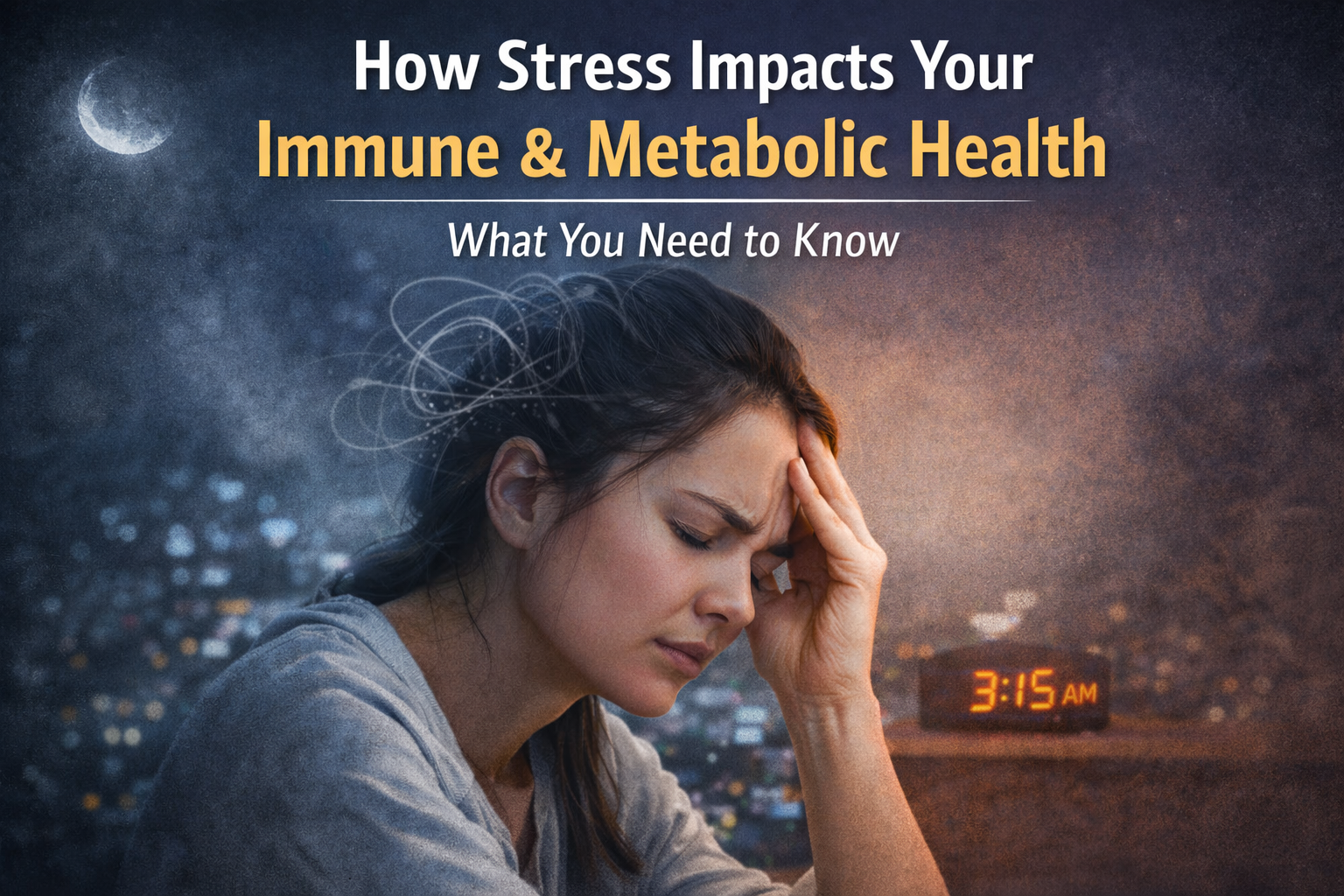
How Stress Affects Metabolic Health (And Why It’s Not “All in Your Head”)
If you’ve been doing “all the right things” and still feel stuck, low energy, cravings, stubborn weight, poor sleep, you’re not alone.
This is one of the most common patterns I see in women 40+.
And for many people, the missing piece isn’t more discipline.
It’s stress.
Not stress as an emotion, but stress as a biological signal that influences hormones, blood sugar, sleep, appetite, and how your body uses energy.
In other words, stress can quietly impact metabolism, even when nutrition and exercise look “good on paper.”
A Story I See Often (And Why It Matters)
I once worked with a client (I’ll call her Maria) who came to me exhausted and frustrated.
She wasn’t overeating. She exercised regularly. She genuinely wanted to feel better.
But she felt like her body was working against her.
Her energy was flat. Her sleep was inconsistent. She caught every bug going around. And her cravings were stronger than they “should” be.
As we talked, it became clear that her nervous system had been in a constant state of pressure for years.
-
Heavy mental load
-
Poor sleep quality
-
Little true recovery
-
And workouts that were more punishing than supportive
We didn’t overhaul her life.
We started with simple, realistic shifts:
-
A more consistent bedtime
-
Gentler daily movement
-
A few minutes of breathing or quiet decompression
Over time, something changed.
Her sleep deepened. Her cravings softened. Her energy became more stable.
Nothing dramatic. No extreme plan.
Just a body finally getting enough safety and recovery to start rebalancing.
Why Stress Shows Up in Your Body (Not Just Your Mind)
Stress doesn’t stay in your thoughts.
It shows up in the body through:
-
sleep disruption
-
digestion changes
-
appetite and cravings
-
inflammation
-
immune function
-
energy production
-
hormone signaling
That’s why “just relax” is not helpful advice.
Your body responds to stress through real, measurable mechanisms.
A study summarized by MindBodyGreen found that chronic stress and poor sleep are associated with lower levels of immune cells, which can reduce resilience and recovery over time.
When recovery is compromised, metabolic function is usually affected too.
How Stress Impacts Metabolism in Midlife
Your body is designed to handle short bursts of stress.
A demanding week, a tough conversation, a hard workout, this is normal.
The issue is chronic stress.
When stress is constant, your body doesn’t get the signal that it’s safe.
It stays in a low-level “alert” state, which can affect:
-
sleep and circadian rhythm
-
blood sugar regulation
-
insulin sensitivity
-
hunger hormones
-
cravings and appetite control
-
fat storage patterns
-
energy levels
-
gut function
-
inflammation
This becomes even more relevant in perimenopause and menopause, when hormonal shifts can make the system more sensitive.
So if you’re wondering why weight is harder to lose after 40, why cravings increased, or why your energy feels unpredictable, stress is often part of the picture.
Why Weight Loss Can Feel Harder When You’re Stressed
This is a key concept:
Metabolic health is not just about calories.
It’s about how your body manages energy, adapts to stress, and recovers.
When your body feels under threat (even psychological threat), it tends to:
-
conserve energy
-
increase appetite signals
-
prioritize short-term survival over long-term repair
This is not your body “being stubborn.”
It’s your body being protective.
That’s why many people who are stuck at a plateau are not failing.
They’re simply under-recovered.
The Most Overlooked Metabolic Reset: Recovery
If your goal is sustainable fat loss, better energy, and stable habits, you don’t always need to do more.
Often you need to support the system.
That means focusing on:
-
consistent meals with enough protein and fiber
-
stable blood sugar patterns
-
sleep timing and quality
-
walking and strength training (instead of punishing cardio)
-
nervous system regulation practices
-
realistic routines that reduce overwhelm
These are not “nice extras.”
They are metabolic health foundations.
The Takeaway
Stress is not a personal failure.
It’s not weakness.
And it’s not something you can simply power through.
But stress is something your body responds to physiologically.
If you want better energy, cravings that feel more manageable, improved sleep, and a metabolism that feels more responsive again, stress and nervous system support matter just as much as nutrition and exercise.
Sometimes the biggest shift isn’t doing more.
It’s creating enough internal safety and recovery that your body can finally do what it was designed to do.
Want Support?
If you’re a woman 40+ and you’re feeling stuck with:
-
fatigue
-
stubborn weight changes
-
cravings
-
stress eating
-
sleep struggles
-
perimenopause or menopause symptoms
You don’t have to figure it out alone.
Support that works with your biology (not against it) can change everything.
Source article: New study links stress with lower levels of key immune cells
(MindBodyGreen)
https://www.mindbodygreen.com/articles/new-study-links-stress-with-lower-levels-of-key-immune-cells